Life Science Buffers
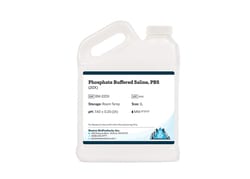
Balanced salt solutions and powders used for molecular, protein, nucleic acid, and cell biology applications including cell culture, electrophoresis, ELISA, and chromatography processes; available in a variety of formulations and grades.
Buffer solutions serve to keep pH (acidity or alkalinity) nearly constant in a variety of chemical and biological applications. For example, a bicarbonate buffer helps maintain the pH of blood, a buffered saline maintains cellular contents at a consistent pH level, and buffers help maintain a narrow pH range for enzymes to function correctly.
Most biological samples used in research are kept at a pH of about 7.4. Common biological buffers used for tissue culture include Dulbeccos phosphate buffered saline (PBS), Tris base, HEPES, MOPS, PIPES, and other formulations developed for specific cell lines or applications. Most buffers used in cell culture are also DNase-, RNase-, and protease-free.
The choice of buffer for a particular biological reaction or site depends on several factors:
- Temperature
- Desired or target pH
- Buffer toxicity (to the system)
- Buffer interactions with other system components
- (1)
- (1)
- (3)
- (1)
- (115)
- (1)
- (2)
- (1)
- (2)
- (2)
- (69)
- (2)
- (1)
- (1)
- (1)
- (1)
- (10)
- (3)
- (2)
- (10)
- (6)
- (2)
- (4)
- (2)
- (10)
- (1)
- (5)
- (5)
- (110)
- (107)
- (1)
- (1)
- (1)
- (1)
- (1)
- (11)
- (2)
- (7)
- (1)
- (1)
- (1)
- (2)
- (6)
- (8)
- (23)
- (1)
- (12)
- (20)
- (1)
- (4)
- (1)
- (12)
- (1)
- (3)
- (1)
- (53)
- (6)
- (5)
- (34)
- (129)
- (2)
- (1)
- (26)
- (2)
- (1)
- (6)
- (1)
- (1)
- (3)
- (19)
- (2)
- (1)
- (26)
- (1)
- (1)
- (6)
- (7)
- (3)
- (8)
- (1)
- (86)
- (155)
- (8)
- (6)
- (10)
- (1)
- (1)
- (4)
- (1)
- (1)
- (1)
- (1)
- (1)
- (2)
- (2)
- (17)
- (143)
- (6)
- (3)
- (1)
- (3)
- (3)
- (7)
- (5)
- (3)
- (8)
- (2)
- (605)
- (5)
- (4)
- (4)
- (114)
- (23)
- (12)
- (48)
- (5)
- (4)
- (2)
- (5)
- (125)
- (2)
- (13)
- (10)
- (3)
- (14)
- (49)
- (1)
- (2)
- (31)
- (13)
- (26)
- (2)
- (4)
- (9)
- (9)
- (23)
- (45)
- (5)
- (55)
- (5)
- (13)
- (1)
- (3)
- (2)
- (3)
- (1)
- (9)
- (1)
- (3)
- (94)
- (1)
- (3)
- (4)
- (4)
- (3)
- (3)
- (3)
- (10)
- (3)
- (31)
- (4)
- (3)
- (9)
- (3)
- (45)
- (1)
- (3)
- (1)
- (4)
- (1)
- (1)
- (2)
- (1)
- (1)
- (3)
- (5)
- (1)
- (4)
- (3)
- (5)
- (1)
- (10)
- (10)
- (6)
- (4)
- (2)
- (5)
- (3)
- (2)
- (5)
- (10)
- (1)
- (10)
- (1)
- (2)
- (3)
- (2)
- (2)
- (2)
- (5)
- (7)
- (1)
- (2)
- (10)
- (4)
- (2)
- (1)
- (1)
- (4)
- (3)
- (3)
- (1)
- (2)
- (1)
- (3)
- (3)
- (2)
- (13)
- (4)
- (1)
- (4)
- (3)
- (2)
- (2)
- (2)
- (1)
- (4)
- (2)
- (4)
- (3)
- (10)
- (1)
- (1)
- (1)
- (1)
- (14)
- (1)
- (38)
- (2)
- (1)
- (1)
- (2)
- (2)
- (11)
- (8)
- (2)
- (1)
- (2)
- (3)
- (1)
- (3)
- (2)
- (1)
- (32)
- (1)
- (5)
- (8)
- (2)
- (14)
- (5)
- (1)
- (3)
- (5)
- (1)
- (22)
- (1)
- (66)
- (11)
- (1)
- (43)
- (1)
- (11)
- (2)
- (1)
- (2)
- (1)
- (11)
- (1)
- (38)
- (2)
- (1)
- (1)
- (7)
- (1)
- (1)
- (11)
- (1)
- (2)
- (1)
- (1)
- (21)
- (5)
- (3)
- (1)
- (17)
- (3)
- (1)
- (4)
- (4)
- (1)
- (6)
- (1)
- (4)
- (77)
- (93)
- (3)
- (6)
- (24)
- (27)
- (1)
- (72)
- (1)
- (23)
- (1)
- (1)
- (56)
- (42)
- (5)
- (2)
- (29)
- (1)
- (1)
- (10)
- (5)
- (5)
- (4)
- (2)
- (1)
- (7)
- (12)
- (2)
- (7)
Filtered Search Results
Sigma Aldrich Fine Chemicals Biosciences TES | 7365-44-8 | MFCD00007532 | 25g
TES | Purity: 0.99 | MW: 229.25 | 7365-44-8 | MFCD00007532 | 25g
Non-distribution item offered as a customer accommodation; additional freight charges may apply.
Learn More
Alkali Scientific Murashige & Skoog Medium with MES Buffer and Vitamins, 24.5 Grams of Powder, Makes 5 Liters of Solution
Small and Specialty Supplier Partner
Small and/or specialty supplier based on Federal laws and SBA requirements.
Learn More
Small and/or specialty supplier based on Federal laws and SBA requirements.
Learn More
Murashige & Skoog Medium with MES Buffer and Vitamins (5 liters, 24.5 grams of powder) is used for plant tissue culture applications that require precise control over pH levels and nutrient availability. The MES buffer stabilizes the pH environment, ensuring that plant cells receive consistent growth conditions. This medium is ideal for a variety of tissue culture applications, including shoot multiplication, regeneration, and plant propagation. The formulation includes essential vitamins and nutrients that support plant growth, making it an essential tool for researchers, plant breeders, and commercial growers. It is commonly used in agricultural laboratories and greenhouses to produce high-quality, healthy plant cultures.
Non-distribution item offered as a customer accommodation; additional freight charges may apply.
Learn More
Research Products International Corp ADA, 25 G
Small and Specialty Supplier Partner
Small and/or specialty supplier based on Federal laws and SBA requirements.
Learn More
Small and/or specialty supplier based on Federal laws and SBA requirements.
Learn More
- Substance Name: [N-(Carbamoylmethyl) iminodiacetic acid)] [N-(2-Aceta-mido)iminodiacetic acid]
- CAS Number: 26239-55-4
- Molecular Formula: C6H10N2O5
- Molecular Weight: 190.2
Non-distribution item offered as a customer accommodation; additional freight charges may apply.
Learn More
Supply Solutions Sigma Aldrich - Mes Hydrate 250Gm
Sigma Aldrich - Mes Hydrate 250Gm
Non-distribution item offered as a customer accommodation; additional freight charges may apply.
Learn More
Medchemexpress LLC 2-Morpholinoethanesulphonic acid monohydrate | 145224-94-8 | 99.95% | 250 MG
Small and Specialty Supplier Partner
Small and/or specialty supplier based on Federal laws and SBA requirements.
Learn More
Small and/or specialty supplier based on Federal laws and SBA requirements.
Learn More
MES monohydrate is an analytical standard intended for research and analytical applications. It is an amphoteric ion buffer with a buffer capacity ranging from pH 5.5-7.0. As a Good's buffer, it is widely used in biochemistry and molecular biology experiments as a reference standard for assays.
- Used in cell culture
- Used in enzyme activity determination
- Used in electrophoresis
- Used in protein studies
- Commonly used in qualitative, quantitative, and methodological research experiments in HPLC, GC, and MS
Non-distribution item offered as a customer accommodation; additional freight charges may apply.
Learn More
Research Products International Corp HEPES, Free Acid, 25 KG
Small and Specialty Supplier Partner
Small and/or specialty supplier based on Federal laws and SBA requirements.
Learn More
Small and/or specialty supplier based on Federal laws and SBA requirements.
Learn More
HEPES, Free Acid (4-(2-Hydroxyethyl)piperazine-1-ethanesulfonic acid), is a zwitterionic buffer.
In the life science field, HEPES, Free Acid, is primarily utilized as a buffering agent to maintain a stable pH in various experimental procedures. It is particularly effective in the pH range of 6.8 to 8.2, making it suitable for applications requiring slightly acidic to neutral pH conditions.
HEPES, Free Acid, is commonly used in cell culture media, protein purification, and enzyme assays where a specific pH range needs to be maintained. Its buffering capacity and stability within the desired pH range make it valuable in these applications.
One of the significant advantages of HEPES, Free Acid, is its compatibility with biological systems and enzymes. It exhibits minimal interference with enzymatic activity and other biological processes, ensuring reliable and accurate results.
Non-distribution item offered as a customer accommodation; additional freight charges may apply.
Learn More
Bioworld ADA Buffer, 0.2M, pH 6.0, 250 mL
Product DescriptionADA (N-(2-acetamido)iminodiacetic acid) buffer has a concentration of 0.2M and a pH value of 6.0. It has a molecular weight of 190.2 and formula of C6H10N2O5. ADA is a zwitterionic buffer used in biochemistry and molecular biology, such as its use in protein-free medium for supporting chick embryo fibroblasts. It has also been shown to interfere with color development in bicinchoninic acid assay (BCA) for protein quantitation and used in isoelectric focusing of proteins in immobilized pH gradients.For laboratory use only. Not fit for agricultural, household, clinical use or human consumption.
Non-distribution item offered as a customer accommodation; additional freight charges may apply.
Learn More
Sigma Aldrich Fine Chemicals Biosciences BES sodium salt 99 titrati500G
BES sodium salt 99 titrati500G
Non-distribution item offered as a customer accommodation; additional freight charges may apply.
Learn More
Sigma Aldrich Fine Chemicals Biosciences MES hydrate 99.5 titration50KG
MES is one of the Good buffers the most extensively used biological buffers. MES is a zwitterionic N-substituted aminosulfonic acid with a morpholinic ring. It does not form complexes with majority of the metals used in environmental and biological studies. It is easily soluble in water and has minimum lipid solubility making it impermeable to membranes.
Non-distribution item offered as a customer accommodation; additional freight charges may apply.
Learn More
Chem-Impex International, Inc. Piperazine-N,N'-bis(2-ethanesulfonic acid) 1.5 sodium salt | 100037-69-2 | MFCD00066393 | 250G
Piperazine-N,N'-bis(2-ethanesulfonic acid) 1.5 sodium salt, 100037-69-2, MFCD00066393, 250G
Non-distribution item offered as a customer accommodation; additional freight charges may apply.
Learn More
Alkali Scientific MES Monohydrate [2 (N Morpholino) ethanesulfonic acid], 250 G
Small and Specialty Supplier Partner
Small and/or specialty supplier based on Federal laws and SBA requirements.
Learn More
Small and/or specialty supplier based on Federal laws and SBA requirements.
Learn More
MES Monohydrate (2-(N-Morpholino) ethanesulfonic acid) in a 250g volume is a biochemical reagent designed for pH buffering in biological and chemical experiments. MES is widely used for maintaining a stable pH in laboratory applications such as protein analysis, enzyme assays, and cell culture. This specific size is ideal for smaller volume experiments where larger quantities are unnecessary. MES provides a precise and consistent pH environment, making it invaluable in research involving electrophoresis, chromatography, and other biochemical processes. Its non-interfering nature with biological systems ensures that it does not affect the results of sensitive assays and experiments, especially in molecular biology.
Non-distribution item offered as a customer accommodation; additional freight charges may apply.
Learn More
Alkali Scientific MES Buffer, Anhydrous, 5 Kg
Small and Specialty Supplier Partner
Small and/or specialty supplier based on Federal laws and SBA requirements.
Learn More
Small and/or specialty supplier based on Federal laws and SBA requirements.
Learn More
MES (2-(N-morpholino)ethanesulfonic acid) anhydrous is a biochemical reagent designed for pH buffering in laboratory applications. This 5kg volume of MES anhydrous is used to prepare MES buffers that provide a stable pH range, particularly for biological assays and biochemical studies. MES is widely used in enzyme reactions, protein stabilization, and tissue culture media where maintaining a consistent acidic pH is critical. It is particularly effective at buffering in the pH range of 5.5 to 6.7, making it suitable for various biochemical processes, including those in protein chemistry and molecular biology. MES is often utilized in electrophoresis, chromatography, and other sensitive experiments requiring precise pH control.
Non-distribution item offered as a customer accommodation; additional freight charges may apply.
Learn More
Alkali Scientific POPSO, Free Acid, [Piperazine N N' bis(2 hydroxypropane sulfonic acid)], 25 G
Small and Specialty Supplier Partner
Small and/or specialty supplier based on Federal laws and SBA requirements.
Learn More
Small and/or specialty supplier based on Federal laws and SBA requirements.
Learn More
POPSO (Free Acid), Laboratory Grade, is available in a 25g package and is used in a wide range of biochemical and molecular biology applications. It is commonly used as a buffering agent to maintain a stable pH environment during protein analysis, enzyme assays, and other scientific procedures. POPSO is known for its effectiveness in maintaining physiological pH ranges, making it ideal for cell culture, biochemical reactions, and analytical studies. The reagent is available in a convenient 25g size, perfect for smaller experiments and academic research, ensuring reliable performance in maintaining pH stability during laboratory work.
Non-distribution item offered as a customer accommodation; additional freight charges may apply.
Learn More
Alkali Scientific HEPES, Sodium Salt [N (2 Hydroxyethyl) piperazine N' (2 ethanesulfonic acid)], 1 Kg
Small and Specialty Supplier Partner
Small and/or specialty supplier based on Federal laws and SBA requirements.
Learn More
Small and/or specialty supplier based on Federal laws and SBA requirements.
Learn More
HEPES, Sodium Salt is a widely used biochemical reagent for maintaining pH stability in biological and chemical applications. This 1kg package is perfect for laboratories that require larger quantities of buffer for cell culture, protein analysis, or drug formulation. HEPES sodium salt is effective in the pH range of 6.8–8.2, ensuring that experiments are conducted under optimal conditions. The reagent's excellent buffering capacity and low toxicity to cells make it ideal for long-term cell culture and biochemical assays, providing reliable results and maintaining physiological pH for sensitive biological processes.
Non-distribution item offered as a customer accommodation; additional freight charges may apply.
Learn More
Dojindo Molecular Technologies Inc PIPES (25G), Good's buffer, CAS: 5625-37-6, pka=6.8, Active pH 6.1-7.5, made in Japan
Small and Specialty Supplier Partner
Small and/or specialty supplier based on Federal laws and SBA requirements.
Learn More
Small and/or specialty supplier based on Federal laws and SBA requirements.
Learn More
In biological experiments, it is important to maintain the pH of the solutions used. Buffers, which are mixtures of weak acids and their appropriate conjugate bases, are commonly used in these experiments. Most biological reactions occur when the buffer is at its effective pH range of 6 to 8. Furthermore, the acids and bases used in the biological reaction should not produce chelates with metal ions. For these reasons, Dr. Good developed several aminoethane and aminopropane sulfonic acids that are now widely used for biological research and analysis. Goods buffers have the following characteristics: 1) High water-solubility. 2) Low cell membrane permeability. 3) Consistent acid-base dissociation constants. 4) Low metal chelating capability. 5) High chemical stability. 6) Low absorption spectra in UV and visible regions.
Non-distribution item offered as a customer accommodation; additional freight charges may apply.
Learn More